
Cost of losing 1 in 3 new patient calls even before they reach your front desk

The gap between a thriving dental practice and a stagnant one often comes down to a single, overlooked metric: what happens when the phone rings.
You spend thousands of dollars every month on SEO, Google Ads, and community marketing to attract new patients. But recent data reveals a massive leak in that funnel. A study tracking over 4,200 inbound calls across dozens of dental practices uncovered a startling reality: 38% of inbound calls go unanswered during normal business hours.
That means more than one in three potential patients are met with hold music, a voicemail prompt, or an endless ring. This article breaks down exactly where those patients go, why traditional front desks are structurally overloaded, and how modern technology is permanently closing the gap.
The Phantom Callers: Where Do They Go?
Most practice owners operate under a comforting, yet false, assumption: If it’s important, they’ll leave a voicemail.
The data paints a much harsher picture. Industry benchmarks show that a staggering 78% of patients who reach a voicemail system hang up without leaving a message. They don’t try again later, and they don’t send an email.
Worse, 67% of those callers immediately dial a competing dental office. Your marketing budget worked perfectly to generate a warm lead, but the failure to connect at the final hurdle just funded a competitor’s growth.
Voicemail is not a safety net for your practice; it is a trapdoor.
Why Your Front Desk is Set Up to Fail
It is easy to blame missed calls on staff negligence, but the reality is that your dental receptionist is likely caught in an impossible balancing act. The traditional front desk is simply asked to do too many things at once.
The Midday and After-Hours Blackout
Call volume doesn’t pause when your staff needs to eat. Midday and late afternoon are prime calling windows because patients are on their own lunch breaks. Yet, many practices still route phones to voicemail between noon and 1:00 PM. Once the doors close at 5:00 PM, the phones go entirely dark. During these crucial windows, missed call rates regularly exceed 50%.
A human can only hold one effective conversation at a time. During Monday morning rushes or post-holiday spikes, two or three calls often arrive simultaneously. This leads to “call stacking,” where callers two and three are placed on indefinite hold or pushed to voicemail. Because older phone systems don’t flag dropped hold queues, management rarely sees the true volume of missed opportunities.
The In-Person Priority
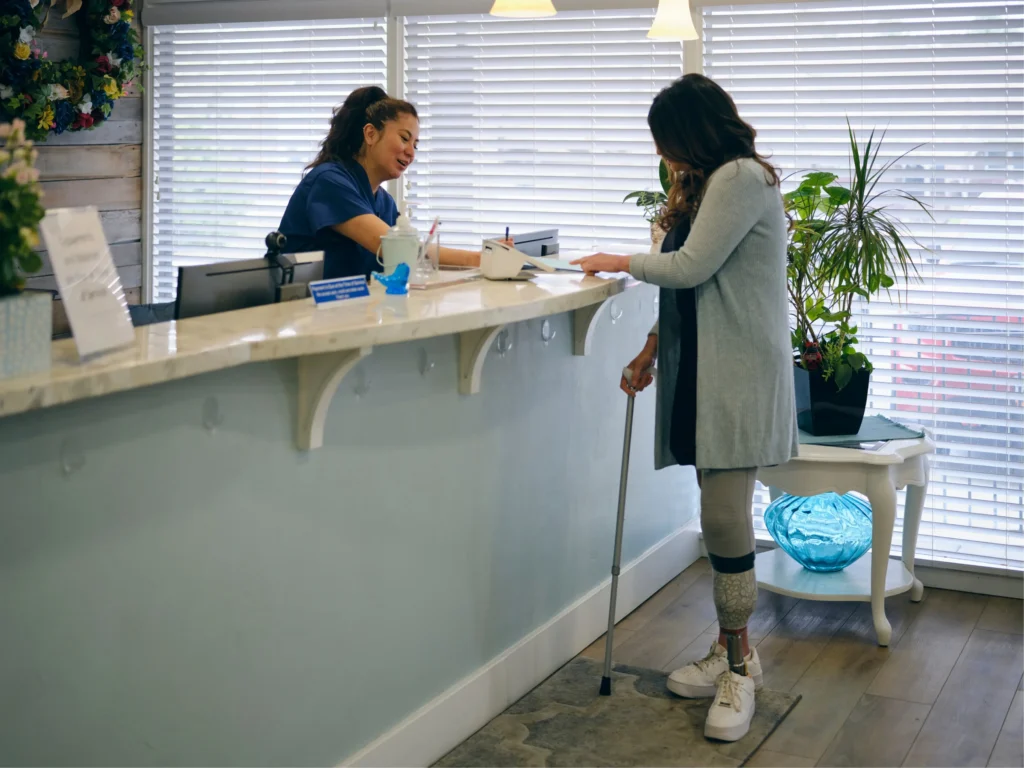
Consider a typical morning: three patients are checking in, the hygienist needs a chart, and a complex insurance pre-authorization is pending. When a patient is standing physically at the counter and the phone rings, the in-person patient wins every time. The caller gets ignored.
The Staggering Financial Toll of Silence
Every missed call carries a hard cost. For existing patients, it breeds frustration. For new patients, it is immediate, unrecoverable lost revenue.
Industry CPAs and data analysts place the first-visit value of a new dental patient—encompassing the initial exam, X-rays, cleaning, and immediate minor treatments—at roughly $850.
But the true cost requires looking long-term. A patient who stays with your practice for five to ten years generates between $5,000 and $8,000 in lifetime value (LTV) through regular cleanings, restorative work, and family referrals. When you miss that initial call, you don’t just lose $850; you lose a decade of loyalty.
Furthermore, data shows that new patient calls only convert to scheduled appointments about 25% of the time, even when answered. They are already the hardest demographic to capture, making it mathematically disastrous to miss their calls in the first place.
The Bandaids That Don’t Stick
Practices have tried solving this for years, but traditional solutions only address symptoms, not the root cause.
Hiring More Staff: Adding another full-time employee costs upwards of $50,000 a year in salary and benefits. Even with a second person, you still cannot cover 24/7 hours, sick days, or unpredictable volume spikes.
Traditional Call Centers: Off-site operators often lack dental terminology context. More importantly, they cannot integrate with your Practice Management System (PMS). They simply take a message and email your team, creating more administrative follow-up work while the patient remains unscheduled.
The Shift to Intelligent Automation
To permanently eliminate the revenue drain, phones must be answered by a system capable of actually scheduling the patient, in real-time, around the clock. This is why the adoption of an ai dental receptionist is rapidly becoming the industry standard.
Unlike a basic answering service, a modern dental reception ai acts as a fully integrated extension of your staff. It answers on the first ring, speaks conversationally using natural language, understands dental procedures, and most importantly, connects seamlessly to your existing PMS (like Dentrix, Eaglesoft, Open Dental, or Curve).
When a patient calls at 8:00 PM on a Sunday, an ai receptionist for dentist practices doesn’t just take a message. It checks your real-time calendar availability, books the appointment directly into your system, and confirms it with the patient.
By handling multiple calls simultaneously, this technology ensures zero hold times, speaks multiple languages, and never takes a lunch break. The result is a 100% answer rate, capturing appointments that would have otherwise gone to the office down the street.
Stop the Bleeding This Week
You cannot fix a leak you haven’t measured. To start recovering lost revenue, take these three steps immediately:
Audit Your Call Logs: Pull your phone system’s reports for the last 30 days. Compare total inbound calls against answered calls. Identify your true abandonment rate.
Calculate Your Specific Loss: Multiply your monthly missed calls by your average new patient ratio, and then by $850. The resulting number is the exact amount of immediate revenue left on the table last month.
Test an Automated Solution: Many AI call-handling platforms offer risk-free trial periods. Start by routing your after-hours and overflow calls to the AI, and measure the influx of automatically booked appointments on your calendar.
The practices that move to eliminate missed calls today will capture the market share their competitors are still sending to voicemail. Every day you wait is another patient you will never get back.
Our Latest Post
Read out our new latest posts.
How Concurrent AI Call Handling Saves Your Dental Front Desk

How AI Dental Receptionist Secures High-Value Appointments


3 Responses